
Blur review (Venice Immersive)

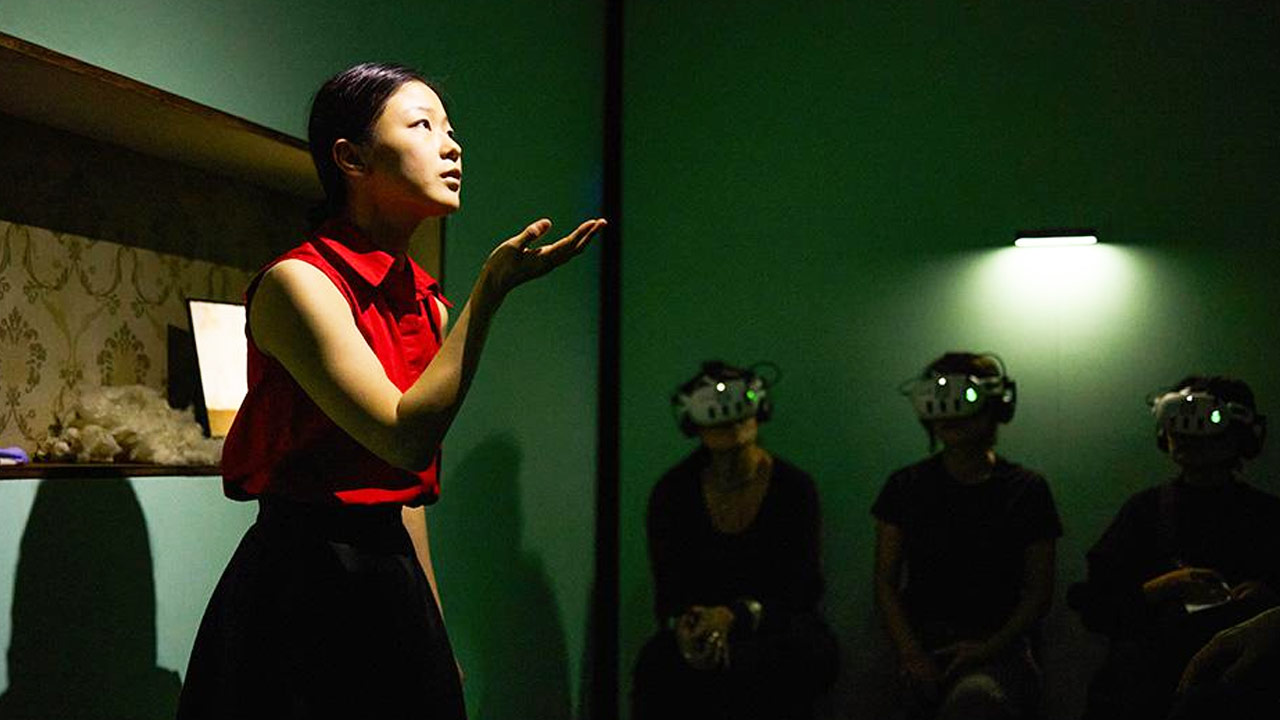

This hybrid mixed reality and immersive theatre experience from co-directors Craig Quintero and Phoebe Greenberg is a cautionary tale about the dangers of genetic mutations and the human desire to transcend mortality. To describe Blur as a great example of visual storytelling risks reducing the striking breadth and impact of the work, which combines actual actors with virtual elements and requires the audience—“participants” may be a better term—to physically walk through digitally augmented spaces.
At one point I discovered myself whooshing through a post-apocalyptic, desert-like setting, with actual wind—well, fan-powered air—blowing on my face. This sensation felt paradoxical: surprising in the sense that it was an unexpected addition, yet also kind of natural—a logical experiential extension of the content.

Directors: Craig Quintero, Phoebe Greenberg
Running time: 50 minutes
Experienced at: Venice Immersive 2025
Despite all this, I remain drawn to those words, “great visual storytelling.” The aforementioned themes resonate clearly despite very little dialogue throughout the production’s 50-minute runtime. Its images are surreal, creepy, and poignant—sometimes all at once. At one point a half-lady, half-animal, with two goat heads protruding from either side of her neck, performed a strange dance in front of me. In another, variations of the same boy, cloned into four identical versions, stared longingly into my eyes.
In virtual reality, when performers look into the camera, it creates the opposite effect of moments in movies that “break the fourth wall.” In VR there is no fourth wall—it’s been absorbed into the virtual bubble. When performers look into the camera, they draw us in; they bring us closer. It feels like they’re looking right at us—even into us.
The first of several “wow” factors in Blur occurs near the beginning, after each participant (there were six of us when I attended) is led individually into a small waiting room. Here we watch, through our headsets, an actual performer in a red dress enter and command the room. When she blows onto her right hand—the kind of breath one applies to a dandelion after making a wish—our vision switches to a virtual rendering of the room, and the lady becomes a virtual rendering of herself.
This is pretty trippy, but things quickly escalate. A path appears and the woman walks down it. We’re clearly intended to follow, but we know there’s a real wall behind her: we saw it ourselves in our physical reality just a few seconds ago. For a moment I felt torn, my brain weighing the known versus the improbable, telling me to go, telling me not to go.
I journeyed forward onto the virtual path, as I suppose everybody did, and only later—after the experience concluded—thought about how that wall must have been removed so quickly. The term “mixed reality,” as its name implies, refers to a combination of physical and virtual elements. In this moment, the known wall disappearing and the unknown path emerging isn’t just a matter of overlaying digital components, but of rearranging the properties of physical reality to enable a function within the narrative world. It’s a process comparable to stagehands moving scenery in traditional theatre, but here, concealing this act doesn’t need the cover of darkness; some mixed reality trickery can do it.

Shortly afterward, all six participants are clustered together, having been directed to stand on a virtual platform. The platform goes down, down, down, many meters beneath the earth’s surface—moving virtually of course, though it feels thrillingly real. One of the essential camera perspectives of virtual reality, returned to time and time again, combines stillness and motion, the viewer/participant/immersant in a fixed position while the virtual bubble moves. Most commonly this is used to go forwards—a rollercoaster ride being the classic, trite example, commonly deployed for cheap amusement-park thrills.
Vertical movement is less exploited but can be just as impactful. In Blur, it’s a fleeting passageway, a kind of narrative thoroughfare connecting one scene to the next. But in the PSVR2 production Horizon: Call of the Wild it’s threaded throughout the experience. This game does a fine job of weaving together plot progression with verticality: the deeper we get into the story, the higher we get virtually, creating a powerful sense that things are scaling up, heading towards a literal and metaphoric summit.
Blur is a more kaleidoscopic experience, dizzyingly strange and thrilling. It’s abstract in some senses but wholly effective in painting a picture—many pictures, in fact; it’s kaleidoscopic—of a world that went wrong, a technological journey that went bad, a series of paths we shouldn’t have gone down. It’s a focused work, but it’s alive and fluid, morphing and metastasizing in the moment and later in the mind. I’ve never experienced a production quite like it; afterwards, when I bumped into and met Quintero—the co-director—all that came out of my mouth was “wow.”