
Asteroid review (Venice Immersive)


Asteroid is a short, space-set, high-end 180 video bookended by AI-powered interactive moments, notable partly because of the device it premieres on—Samsung’s unreleased new headset, which I tested during this year’s Venice Immersive. Also partly because of the talent involved: the experience was co-directed by American filmmaker Doug Liman, best-known for blockbusters such as The Bourne Identity and the rootin-tootin’ time loop movie Edge of Tomorrow. The cast is impressive too, including Hailee Steinfeld (who was Oscar-nominated for True Grit), veteran Ron Perlman (in a sadly underwritten role), and NFL star DK Metcalf (whose involvement is a little odd—I’ll get to that later).
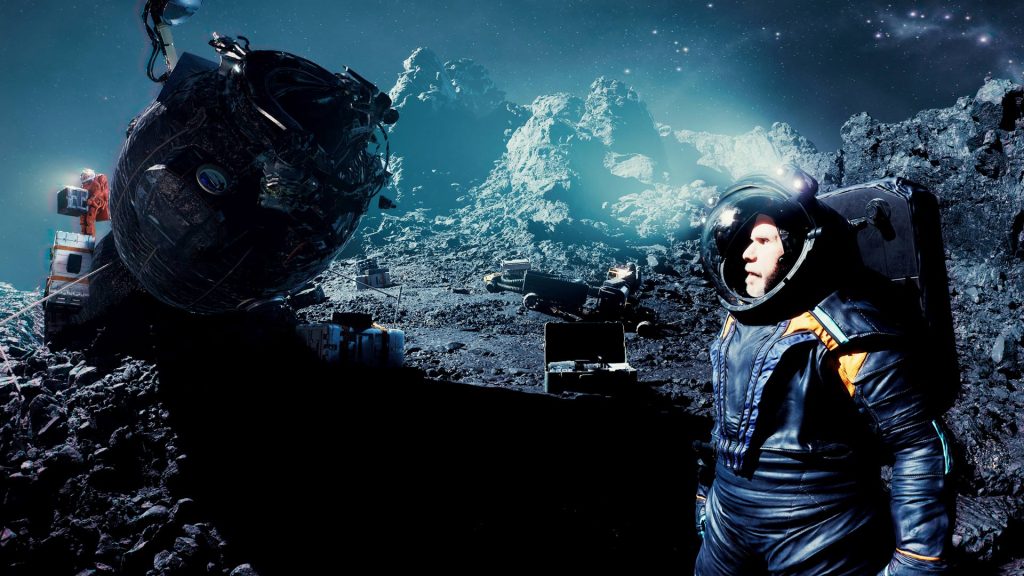
Asteroid’s lean, spectacle-driven plot centers on the ill-fated voyage of a vessel carrying strangers who head to an asteroid, intending to mine it of precious natural resources and return home rich. Naturally, things go terribly wrong, with only Steinfeld’s character making it back. Traumatised, she’s grilled by authorities, her recollections triggering flashbacks that return us to the ship—and to the icy surface of the asteroid—painting a more complete picture of what transpired. I say more because the films whirlwind flashback structure is discombobulating, perhaps more befitting of a feature-length format; I spent most of the runtime trying to get my bearings.
Directors: Doug Liman, Julina Tatlock, Jed Weintrob
Screenplay: Doug Liman
Experienced at: Venice Immersive 2025
Visually, the experience is chaotic, claustrophobic, and strangely—given its outer-space setting—closed-in, the directors pressing us right up against the performers. Some flourishes pop: for instance, seeing through a character’s space helmet, after having virtually inhabited them. I would’ve liked more of this, perhaps even the entire production unfolding from a first-person perspective—like Robert Rodriguez’s superior 180 film THE LIMIT, in which we embody a cyborg. That film felt like a genuine attempt to reinvent motion pictures for the 180 format. Too often, Asteroid feels crammed and airless; I longed for wider shots that could give the scenes—and the viewer—room to breathe.
The experience ends with a short, game-like segment in which we help Metcalf’s character, which felt fiddly and extraneous. More compelling is the interactive prelude: an AI-powered chatbot-style encounter where we verbally chat with Metcalf, who responds in real-time. This fits oddly with the rest of the experience, in the sense that it exists outside the narrative world; our conversation is with Metcalf, not his character.
Still, it’s an intriguing application of technology likely to have a profound impact in coming years. It’s a thrill when we speak to virtual characters who listen and reply; before too long, we’ll surely remember dialogue trees as clunky, archaic creations. A very compelling example of an AI-powered, scenario-driven conversation with a virutal character already exists in the short game When They Came For Us—produced by PETA and free on Meta headsets—in which players debate an alien about the ethics of eating animals.
I’m keen to spend more time with this part of Asteroid—chewing the fat with Metcalf—once it’s properly released. To pull it off, the creators faced an unusual challenge: unlike ChatGPT, their bot needs not just any personality, but one that reflects Metcalf himelf—his quirks, tastes, opinions and backstory. And of course, it needs boundaries, nudging conversations toward some outcomes and away from others.
In the future, how many celebrities will embrace this technology, letting fans chat with virtual versions of themselves—and how many will recoil in horror at the very idea of it? Maybe Metcalf is a trailblazer; maybe his AI presence in Asteroid will outlast the film itself.