
Star Wars: Beyond Victory review – flashes of ingenuity


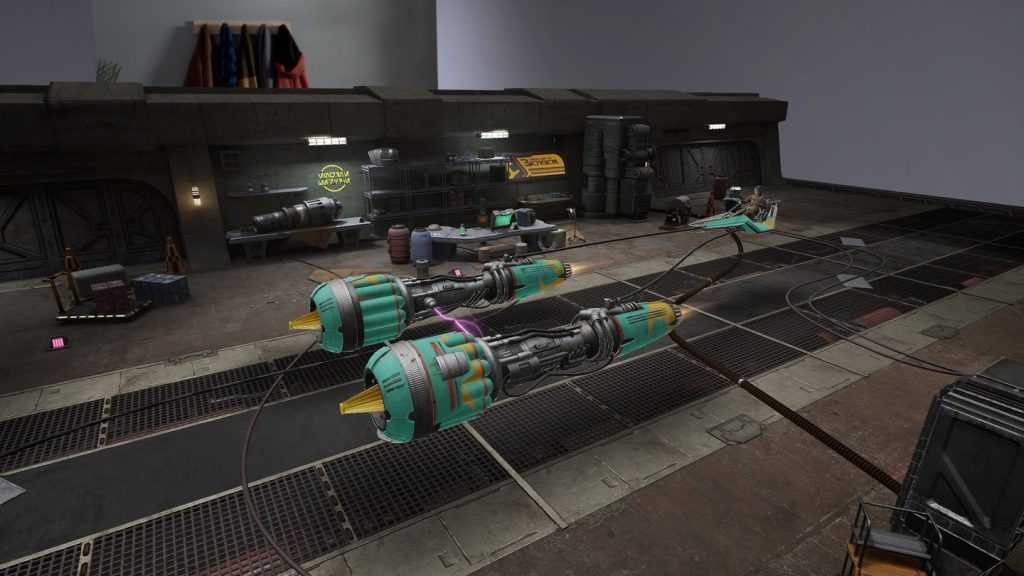
After playing Star Wars: Beyond Victory, I’m convinced that a mixed reality racing game will one day come along and knock our socks off—but this one isn’t it. There are some lovely embellishments, including a tabletop presentation used as a stage for spatial storytelling, diorama-like scenes blooming and rearranging in relatively experimental ways. But the gameplay—the centerpiece attraction being podracing through miniature courses—has a major flaw; more on that later. And the experience as a whole feels suspended in an in-between state: more than a proof-of-concept, but less than a fully rounded stand-alone production.
There are three modes, clearly designed to showcase different aspects of mixed reality: a story campaign that lasts for a few hours, an arcade mode with four tracks, and a mode that allows you to place and resize models of various characters (which is so gimmicky and extraneous it’s barely worth mentioning).
Developer: Industrial Light and Magic
Release date: October 7, 2025
Available on: Quest headsets
Experienced on: Meta Quest 3
The story campaign takes about three hours to complete and follows Volo Bolus, a crack podracer who’s sweet-natured but a bit of a simpleton. Ergo: fresh meat for a posse of criminals—including the shifty, camel-faced Sebulba, a side character from The Phantom Menace—who need a racer in order to provide an elaborate distraction while they pull off a massive heist.
The story has elements of an in-over-your-head crime drama, but the stakes feel low and the tone squeaky clean. Visually, though, it’s a bit banged up, in that beautifully scrappy Star Wars way—slick but scuff-marked.
Cutscene-like moments unfold at shifting scales: sometimes the characters are toy solider-sized, sometimes as large as dolls, and always rearrangeable in that you can sidle up to them to examine small details, or step back and watch whole scenes play out. The shifting third-person perspective, and the board-like stage on which the drama unfolds, reminded me of Ahoy! From Picardy, an elegantly crafted dioramic experience that plays out on a dome-like platform, telling the story of a lonely inventor who builds a rain-making machine.
Beyond Victory periodically switches to first-person, wraparound VR, which for me was one perspective change too many, detracting from the mixed reality aspects—its core feature and raison d’être. In the VR environments, the developers have an annoying tendency to keep us contained within particular spaces using the laziest of techniques: we simply cannot move forward—pushing against an invisible wall—even if there’s nothing in front of us. This kind of immersion-breaking is never necessary; there are always ways to restrict movement through spatial design.
Having scenes unfold in mixed reality allows the space around them to be used also; space that belongs to our world rather than the imagined one. During a key race scene, for instance, TIE fighters join in on the action, chasing Volo and appearing above and around the virtual table top, floating outside the literal parameters of the narrative world. These elements feel cursory, but it’s exhilarating to see them being used at a time when mixed reality storytelling is in its infancy, grammar and syntax still being formed.
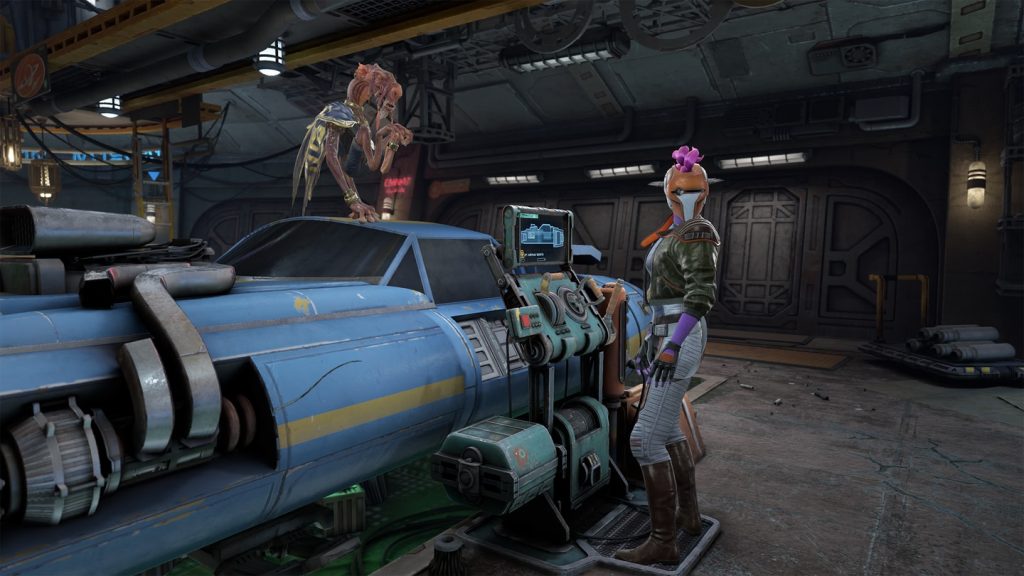
Initially I got a kick out of the pod racing, which really does feel like a new variety of racing games. But that thrill wore off and agitation kicked in when the gameplay’s limitations became apparent. The design flaw I mentioned at the beginning of this review is the lack of ability to properly see where you’re going and what’s ahead on the track. The table-like surface has a literal end, but we keep barrelling forward beyond that edge, the (rapidly approaching) things ahead of us revealed at the last moment. I kept hitting things because there’s simply no way to see them coming.
I’m surprised that this problem wasn’t noticed and addressed very early on in development—it’s a biggun. Making things even worse is that the developers actually find a solution: a way of presenting the track that looks great, and reveals much more, while retaining the table-top format. During the final race, the visual perspective tilts downwards, the course extending in front of us in a slide-like contour. We can see well ahead of us, it looks really good, and…it’s over almost as soon as it begins, switching back to the default position. A game presented entirely in this way could’ve been amazing. This one, though, has only flashes of ingenuity.