
The Clouds Are Two Thousand Meters Up review (Venice Immersive)

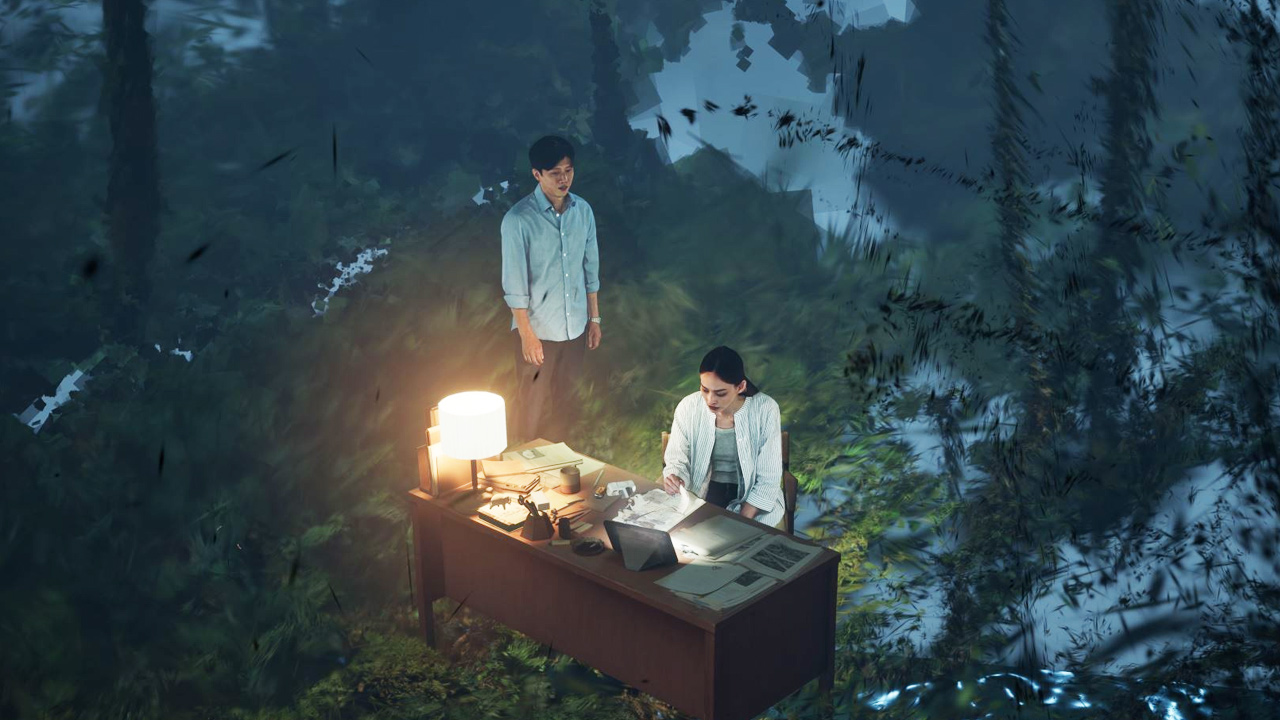

In story-driven virtual reality experiences, environmental and narrative details should be inseparable—wrapped together like a double helix. Premiering at this year’s Venice Immersive, where it won the event’s top gong, director Singing Chen’s exquisitely moving The Clouds Are 2000 Metres Up encapsulates a simple but profound truth: that stories belong to places, and places tell stories. This beautifully crafted free-roaming production lets us follow Guan, a Taiwanese lawyer on a melancholic mission to understand his recently deceased wife by entering the world of her unfinished novel.
It’s visually and emotionally arresting from the opening immersion, set at a busy city intersection where Guan is the only person rendered in vivid, fully formed detail, the others semi-transparent and ghostly. This instantly makes it clear whose story we’re inhabiting and focuses our attention—the first of many examples of how Chen (adapting a short story by novelist Wu Ming-Yi) uses the contents of a scene to steer us towards particular focus points. This is a key concept for spatial storytelling, about shaping attention through space rather than relying on more dictatorial means common in films, such as cuts and camera moves.
Director:
Singing Chen
Screenplay: Singing Chen, Lou Yi-An
Running time: 62 minutes
Experienced at: Venice Immersive 2025
The next example occurs during the same scene, when Guan looks up at a huge screen attached to the side of a building, broadcasting news of a terrible incident that occurred on a train. We instinctively follow his gaze, sharing with him one of those moments in life that rips the ground from beneath your feet. He soon realises his wife was on board, and has died, triggering a cascade of grief-stricken reflections about how he never truly knew her, and the futures they will now never share. The writing, narration and atmospheric elements create an aura of thick, cloudy anguish; at one point my eyes started to water and I wondered whether tears might dampen the headset and compromise the experience.
It takes on lighter, more fantastical qualities when Guan discovers that his wife was working on a novel about an endangered leopard and an ancient fable. One early sequence lays the groundwork for a surreal tone, set in a “cloud data” repository that is at once inside and outside, real and unreal—a liminal mix of memory, fact and fantasy, threaded with visions from different times and spaces. In one striking moment, pages from Guan’s wife’s book cascade through the air like a waterfall, glowing with golden sunlight.
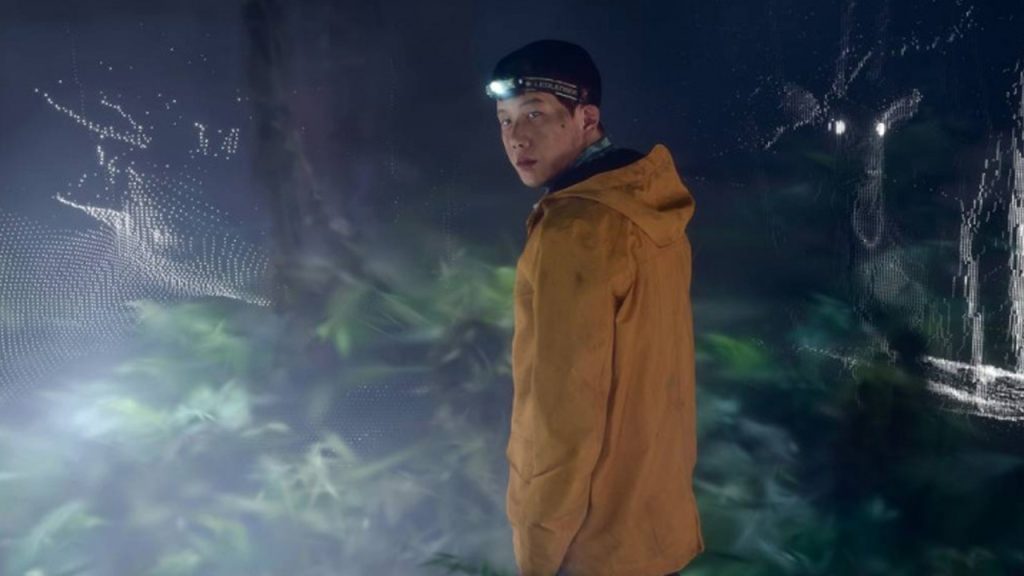
Guan doesn’t know what to do, but feels where he must go. “The only thing I can do now is follow your footsteps into the mountains,” he says. “Even if it changes nothing, I still want to get closer to whatever it is you were trying to find.” His journey leads him to a beautifully rendered forest—realistic, but speckled with magical inferences and bathed in moonlight—which becomes the key setting. At one point I sat down and listened to an ancient tale, told by an indigenous tribesperson beside a campfire: an encounter that tantalisingly bridges ancient oral storytelling and the expressive power of cutting-edge VR.
The Clouds Are 2000 Metres Up was probably the hottest ticket item on this year’s Venice Immersive program. Not only was it terrific, fuelling strong word of mouth, but its hour-long running time and single-user format (with only two adjoining rooms available) limited audiences to about 20 per day. I hope the developers find a way to release it on home platforms, perhaps using controllers instead of free navigation. This might compromise some of its features, particularly its wonderful sense of controlled exploration, but Clouds is simply too good to become another VR production lost in time, never given a permanent home.
Show this to a virtual reality newcomer and it might blow their minds—stirring their imaginations and expanding their sense of where spatial storytelling might be headed. Chen reminds us that in narrative VR, environments should never be mere backdrops, but living spaces where stories and emotions are inseparably entwined.