
L’Ombre review (Venice Immersive)

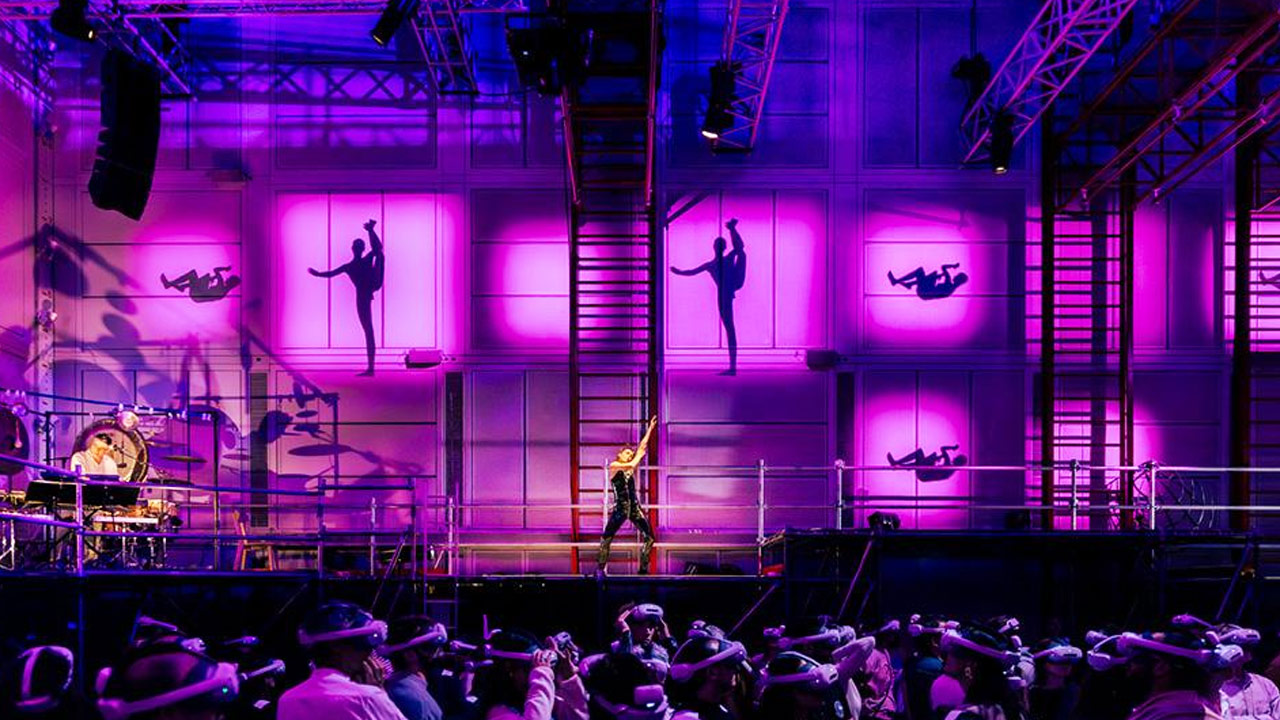

L’Ombre is an hour-long mixed reality dance experience combining a handful of live performers, and a percussionist, with countless virtual extras and all sorts of incandescent digital scaffolding. It’s a France/Taipei co-production, inspired by Hans Christian Andersen’s fairytale The Shadow, that I experienced at Venice Immersive among an audience of 70. It’s an eclectic, enigmatic, emotionally expansive work, full of wild beats and reality-bending illusions. Attempting to articulate exactly what transpires is like trying to describe an abstract painting.
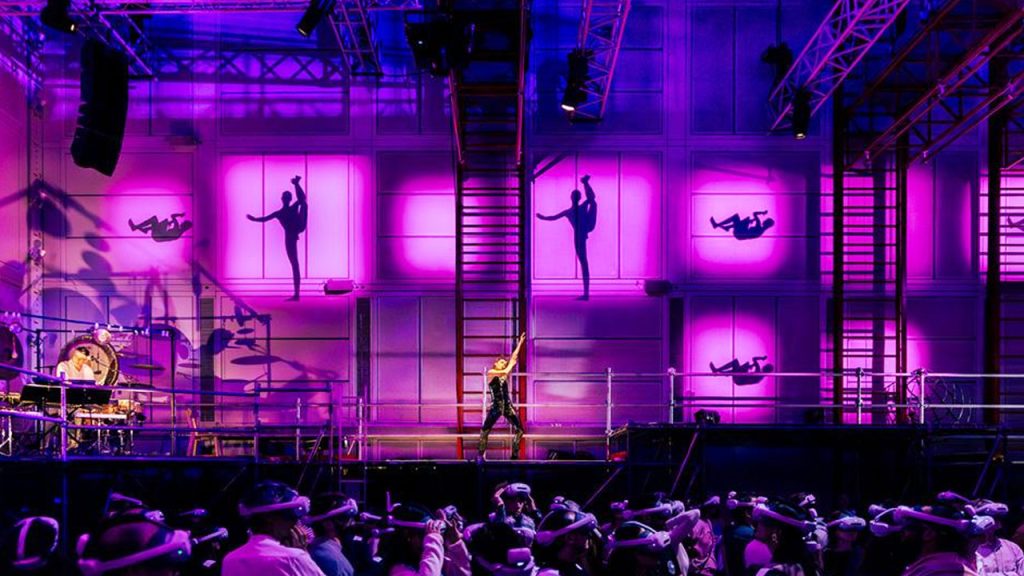
Throughout the experience everybody is seated, wearing headsets, situated inside a large rectangular room. The production design is edgy, with industrial elements, whispers of vaudeville and speakeasies, and occasional visions of cityscapes that come and go. The performers—from dance company Compagnie Blanca Li—are situated in various spots on an elevated stage around us, repositioning themselves at various points but usually remaining on these literal boundaries. The virtual elements however encroach on and disrupt our space—patterns, shapes and strange figures moving among us.
Directors: Blanca Li, Edith Canat De Chizy
Running time: 60 minutes
Experienced at: Venice Immersive 2025
The dance choreography has lots of sharp, jagged movements, the performers often isolated but sometimes coming together—either with each other or with virtual elements they perform alongside. These elements are more than just accoutrements; they’re embedded into the essence of the experience. In one section, the dancers appear to respond to giant outlines of hands, reaching towards them, making pushing and pulling-like motions: a cross-reality to-and-fro. In another, huge creepy figures appear in bright red, monk-like robes, mixed in with the actual dancers.
With the exception of a few things, such as a virtual chandelier hanging above us, which I thought looked very realistic, one can easily differentiate between the real and unreal—partly by design, and partly because the technology is not yet at a point where it can achieve true fidelity to realism. Initially the virtual elements are quite subtle and unobtrusive: for instance, music note-like symbols that float through the air around us. But they build, swirl and swell, like moving matter, as if energised by some strange alien force, evolving into a cavalcade of bizarre phantasmagoria.
The overarching tone feels loud, boisterous, and very French. One section, involving the dancers using umbrellas, with both the performers and props in bright juicy colours, reminded me of Jacques Demy’s great movie musical The Umbrellas of Cherbourg. I wonder if it was an intentional homage.
After the experience, I also wondered if this is the—or perhaps more realistically, a—future for live theatre and musicals. Maybe one day it’ll be common to enter a theatrical space and don mixed reality glasses to augment the production about to unfold. The potential implications for set decoration, scene transitions and sensorial embellishments are profound; a conversation for another time.
Part of the joy of L’Ombre, like theatre, is its ephemerality: the pleasures of experiencing something in the moment, for the moment, extensively rehearsed of course but with a spontaneous buzz that can only arise from the imperfections of cosmic rhythm—the forces and cycles governing our universe. At least when it comes to the human elements; I assume the virtual ones are programmed to remain the same during every performance. Which is another interesting tension: the immaculate beat of the machine versus the wavering heartbeat of the dancer.