
Nevatars review: zany mixed reality animation (Venice Immersive)

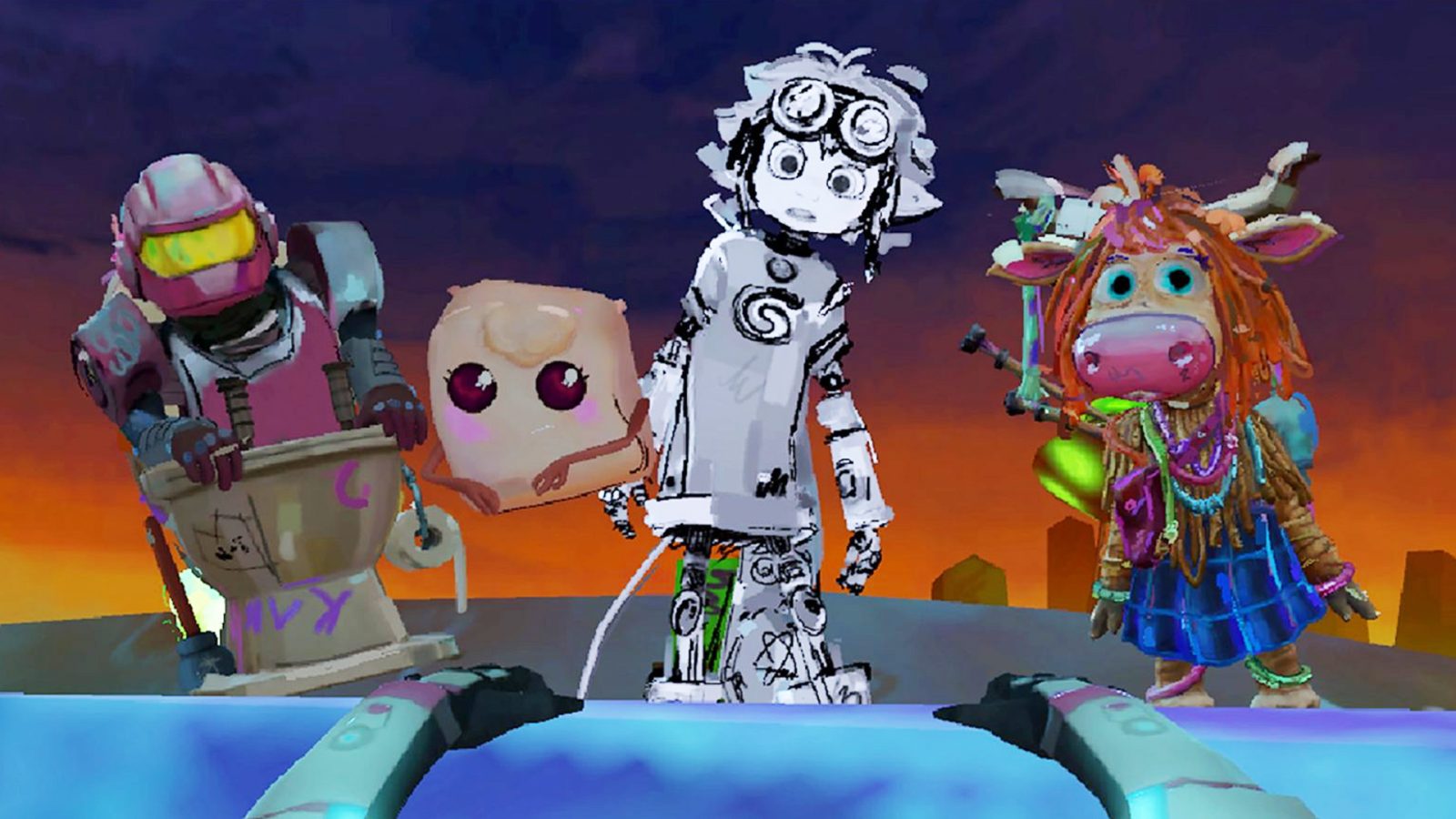

This zany half-hour mixed-reality experience, co-directed by Andy Serkis and Josh Nelson Youssef, imagines a computer folder as a fantastical otherworldly landscape, phosphorescently coloured but junkyard-like, filled with discarded characters created by an aspiring young artist. Aya (voice of Aya) worries that her creations aren’t perfect, so she’s placed them in a computer folder called “Nevatars,” which is one click away from the recycle bin. Just as the characters in Toy Story come alive when nobody’s watching, Aya’s inventions have lives and consciousness of their own, unbeknownst to her.
Billed as a “mixed reality film,” VR and MR enthusiasts will be interested in this production partly for the hardware on which it’s viewable: XREAL’s augmented reality glasses Aura, which were developed in partnership with Google and were, at the time of publishing, yet to receive a release date. They’re spatial computing glasses rather than virtual displays/monitor replacements, meaning they don’t just function as a virtual monitor but can fill the space around you, with added functionality such as hand tracking (a major new feature for smartglasses).
Directors: Andy Serkis, Josh Nelson Youssef
Running time: 31 minutes
Experienced on: XREAL Aura
The experience begins with a diorama-like tableau, depicting Aya at home, in her bedroom, scribbling away at her “cringe drawings,” creating characters we soon encounter – characters who realise that they’re close to oblivion and launch an escape mission to save themselves. These include a scratchy, hand-drawn-looking figure, Trace (voiced by Josh Gad), a marshmallow-like blob, Marshy (voice of Kelly Marie Tran), and a commander-like, vaguely Boba Fett-looking fellow who, for some reason, has half his body stuck in a toilet, named Farty McFly (voice of Steve Zahn).
The aforementioned escape narrative involves the characters crashing and careening through their zanily animated domain. The well-made, enjoyably paced production mostly unfolds in a widescreen, frame-like display area. During this kind of seated experience, which takes place directly in front of the viewer and requires no rotation of the body, content creators tend to feel compelled to fill the space between the screen and spectator. Understandably so: this is the “spatial” aspect of spatial storytelling. Otherwise, why use spatial technology at all?
Ergo: various characters and thingamajigs protrude from the frame, popping out in front of us – a pleasant, narratively inessential novelty. Like the creators of Asteroid, which was commissioned to demonstrate the Google Samsung Galaxy XR headset – and which I experienced last year in the same room at Venice Immersive Island – the Nevatars developers were clearly tasked with showing off Aura’s hardware. Hence the occasional (and equally inessential) moments of light, hand-based interactivity, including instances in which we use our hands to push away elements coming towards us.
Conceiving Nevatars as a production that can translate perfectly well into a flat-screen experience is both a blessing and a curse. The curse: this approach doesn’t push the emerging medium into meaningful territory that other technologies can’t reach. The blessing: it leans on tried-and-tested, broadly appealing motion picture language, executed with some flair and verve.