
Raj’in review: intimately capturing Palestinian displacement (Venice Immersive)

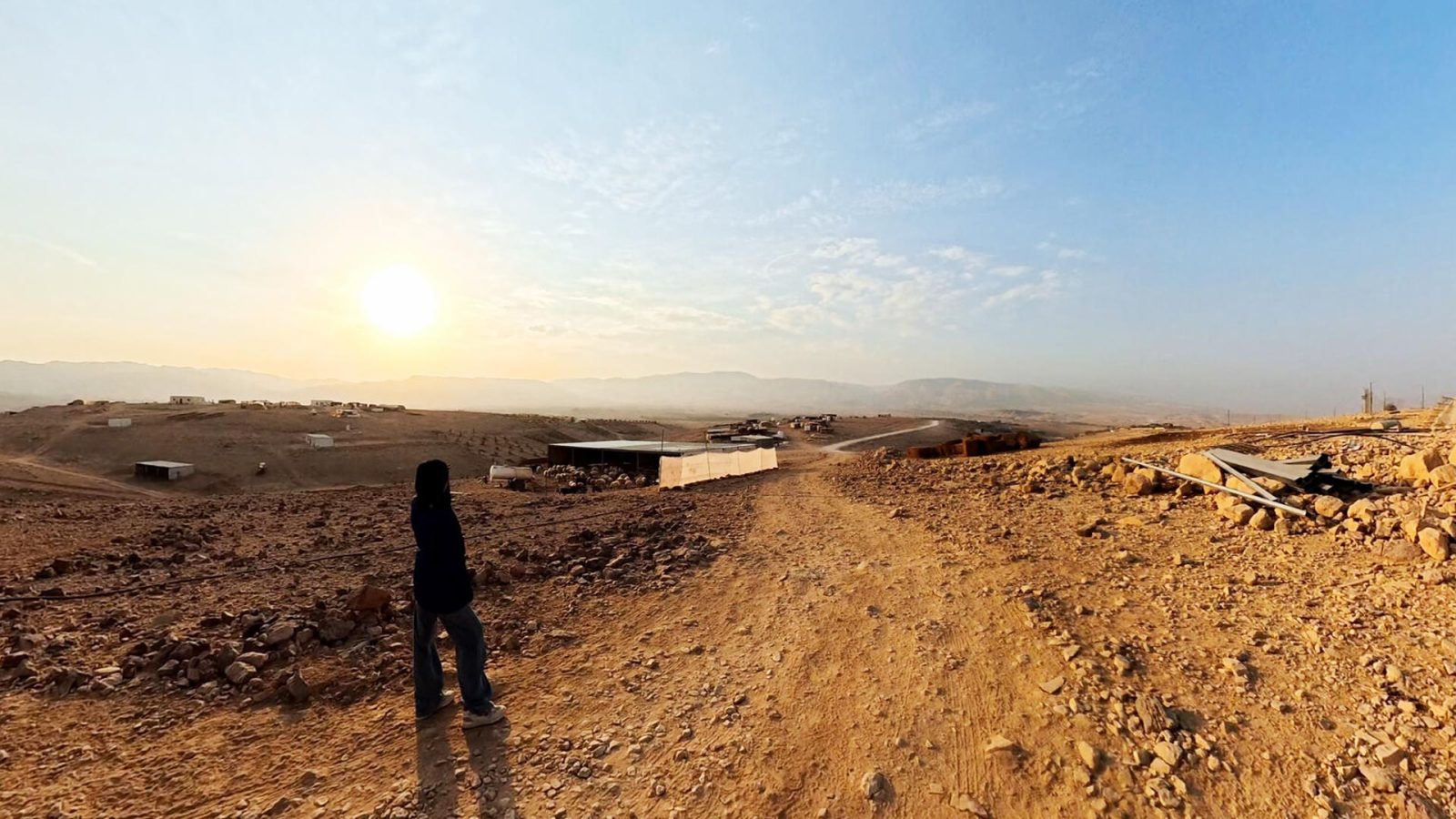

There was a point, during this immensely powerful 360 documentary, when I wondered whether I might cry – and whether my tears might mist up the headset. What a moment of immersion-breaking that would be: the connection to the material so strong it momentarily derails the experience. Raj’in (We shall return) has a unique sense of place, though not of an uplifting or picturesque kind: it’s set in rural Palestinian communities in the West Bank, where residents are continually assaulted by Israeli forces.
These include militia-like groups called “settlers,” who are supported and armed by the government, thus enabled to operate outside the law, with the stated objective of razing entire communities and displacing Palestinian people into concentrated zones. At one point, text appears before us, stating that of the 11 communities captured by co-creators Faiz Abu Rmeleh and Keren Manor, seven have now been entirely destroyed. There is a term to describe this: ethnic cleansing.
Directors: Faiz Abu Rmeleh, Keren Manor
Running time: 24 minutes
Experienced on: Meta Quest 3
As is common in 360 documentaries, Rmeleh and Manor’s cameras tend to be placed in a central position, often capturing large expanses of tortured, detritus-strewn landscape. In one immersion that has stuck in my head, we see a pink couch amid the rubble of what was once a family home, now accessible only through the memories of its former inhabitants. The production also incorporates footage filmed on smartphones, presented in panel and frame-like displays (Experiencing other mediums from inside VR often brings to my mind an old description of virtual reality – coined by academic Brian D’Amato in the early 90s – as “the last medium”. The idea is that all other pre-existing mediums – i.e. movies, paintings, literature, sculpture – can fit inside it. It’s a fascinating argument, up for debate like any other. If it sounds hyperbolic to you, then, what are the exceptions? What mediums don’t fit inside VR?).
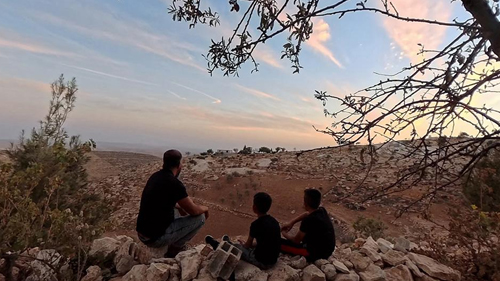
Raj’in is anchored around three protagonists: Jaber, who remains on his land despite relentless attacks; ‘Alya, who sprayed the titular word (meaning “we shall return”) on her home before being forced to leave; and the Hreizat family, who were also forced to relocate. After I came out of the experience, which I watched at Venice Immersive, I had the entirely unexpected honour of meeting Rmeleh, Manor, Jaber, and ‘Alya in person.
The filmmakers spoke with me at length about the despairing situation in Palestine, and their hope that Raj’in might serve as an advocacy tool to spread awareness among the public and policy-makers. Many creatives in the spatial art community have long tired of the term “empathy machine,” which was popularised in relation to virtual reality by VR pioneer Chris Milk. But works of art like Raj’in (We shall return) remind us why the term gained currency in the first place: to highlight the medium’s potential for new forms of emotional connection.