
Real Madrid: The Weight of Greatness – more polished but safe Apple content

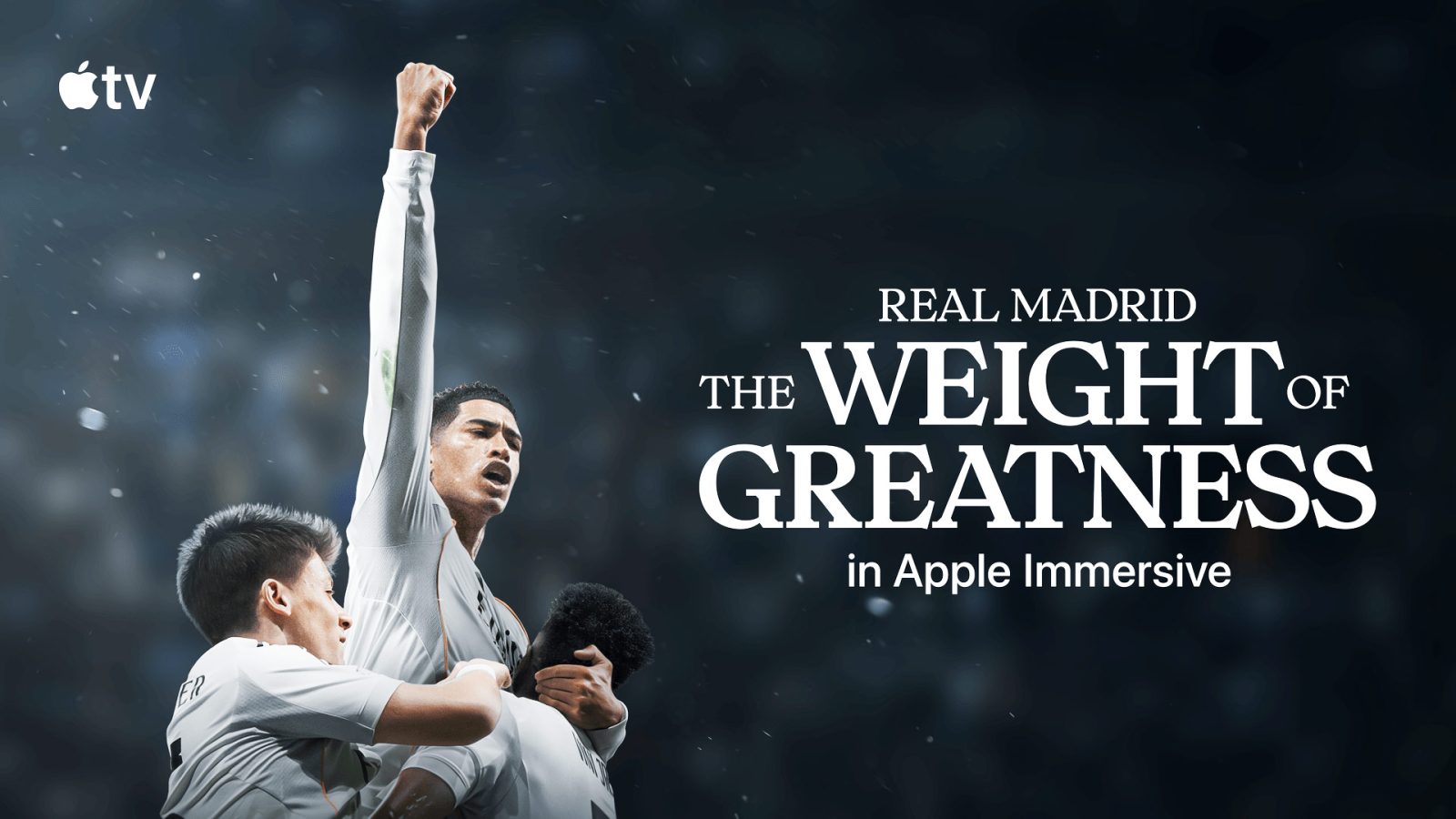

When the Apple Vision Pro arrived, commentators such as myself noted a conspicuous lack of original experiences—yet another example of the tech industry’s frustrating tendency to invest big in new headsets, and little in content. Two years later, in a curious twist, Apple keeps producing original content for the Vision Pro despite a very small audience. This is content, however, of a certain, very limited kind, the company mostly pumping out short-form non-fiction 180-degree videos.
With a 20 minute runtime, sports documentary Real Madrid: The Weight of Greatness (directed by James Marsh and Hector Dockrill) is one of the longer ones, although it still feels brief and clipped—like a chopped-up feature film. Unpacking the status and legacy of Spain’s Real Madrid, which is generally considered the world’s most successful football team (though the Australian in me feels obliged to point out that we call it soccer), the production combines on-the-field action (filmed during the 2025 Champions League) with archival footage, behind-the-scenes insights, and interviews with players and other people of interest.
Directors: James Marsh and Hector Dockrill
Release date: May 22, 2026
Running time: 21 minutes
Experienced on: Apple Vision Pro
It begins at night, the Santiago Bernabéu Stadium lit up, its bright green grass contrasting with a pitch-black sky as the camera glides towards the ground, into the space of Roberto Carlos, who is billed as a “Real Madrid legend”. This introductory moment establishes a visual tendency to film from vantage points inaccessible to human beings—suspended a few metres above the ground, for instance, or descending from greater heights.
This makes sense conceptually, offering a visual experience unobtainable in real-life. But paradoxically, I found the on-the-ground shots often the most engaging: moving through a room, for instance, or perched next to somebody on a bus. It was during these moments I felt most present, and often simply the most visually engaged. This isn’t necessarily a conversation around virtual presence (a long and knotty subject), but it’s certainly in an adjacent space, speaking to visual elements that make us feel connected to the world around us.
The cutting in Real Madrid is careful and selective, maintaining a judicious, stable rhythm. But it feels too much like it’s edited for a normal flat-screen experience. The core question is: why is this in an immersive format? What does this format offer that a traditional flat screen doesn’t? Like much of Apple’s immersive content, it feels cribbed from cinematic language—the equivalent of a video game port, one older format transplanted into a newer one.
And despite those measured cuts, Read Madrid still jumps around too much. We see footage of a match, then people watching it—in the members’ room, in a car, on a phone—then training, then back to the match. Even though the editing is measured, the experience remains a little too discombobulating, as if we’re being shunted from one setting to another without enough sense of why we’re there. This is a problem that most of Apple Vision’s content shares; the big Apple clearly views its Vision Pro videos as more immersive versions of pre-existing motion picture language. The content keeps coming…but it’s of a very safe and polished kind.