
Smithsonian Starstruck: An Immersive Experience review – a walking tour of the cosmos

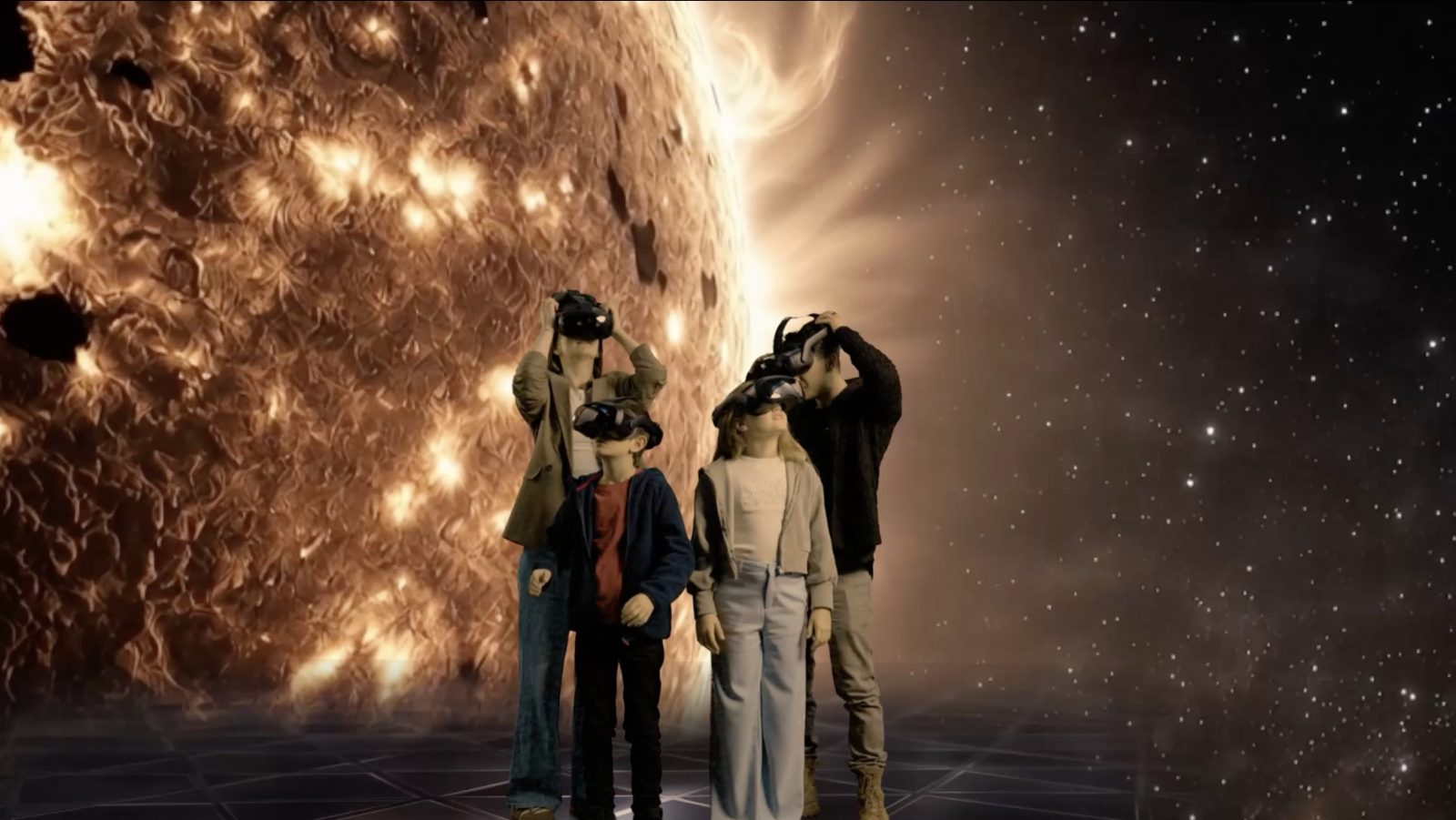

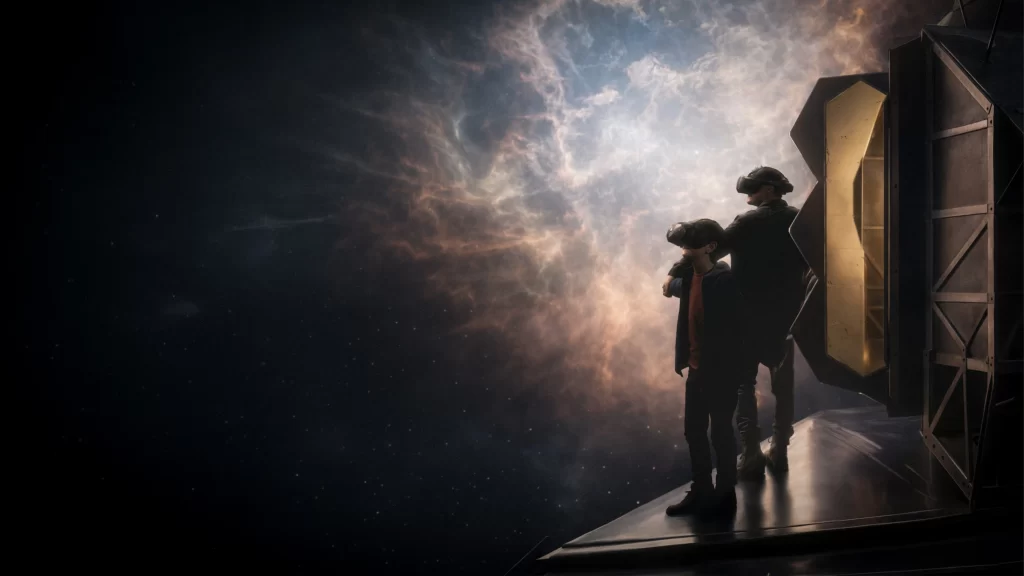
Anyone who’s taken a walking tour at an international landmark will know roughly what to expect from Smithsonian Starstruck: lots of strolling around looking at things, and lots of talking and facts-sharing, relayed by a passionate and knowledgeable guide. Produced by the Smithsonian, Starstruck is a free-roam experience that unfolds in locations just a tad harder to reach than the Louvre or the Vatican, taking us to outer space to witness various cosmic spectacles a la the birth of stars, far-flung planets, an event horizon, a black hole, and even the Big Bang. It delivers the sort of visuality one expects: incomprehensibly vast panoramas, milky colours, radiant lights, shimmering nebulae.
If this sounds wildly ambitious, director Elliott Mizroch resists over-complicating the structure and favours a straightforward approach – leaning on the ancient, evergreen pleasure of being guided through a space.
Director: Elliott Mizrock
Release date: July, 2026
Running time: 40 minutes
Experienced at: Level 1, 206 Bourke Street, Melbourne
It’s a bit of an information overload, cramming an enormous amount of textbook-style material into a roughly 40-minute runtime. But it’s also nice to experience a production so earnest in its educational intent. A friend of mine, who accompanied me the first time I experienced it (I’ve gone twice), commented afterwards on how refreshing it was to see a work of art that takes time and care to explain things – in stark contrast to the brain-mulching continuum of race-to-the-bottom content vying for our attention online.
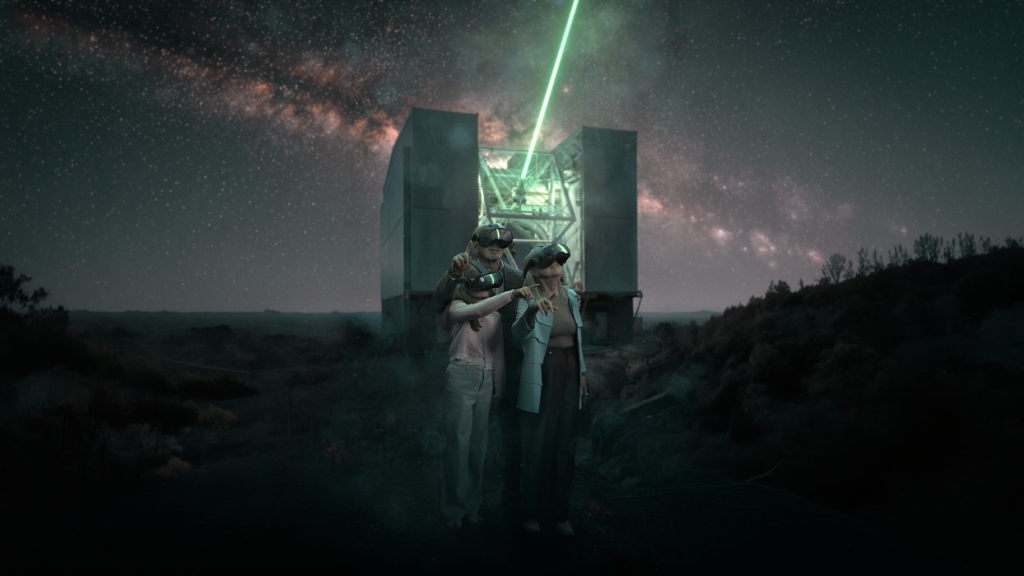
Starstruck begins at the Smithsonian’s Fred Lawrence Whipple Observatory, where our virtual guide, Astro (voiced by James Seawood), encourages us to marvel at the majesty of the stars, reflecting on how humans have looked up and dreamt big since time immemorial. From this early point, we’re directed very clearly and unambiguously, with instructions like “over this way” and “follow me.” We stand on platforms composed of glowing hexagonal tiles, alongside other participants – this is a group experience – who appear as glowing translucent avatars. Both times I experienced Starstruck, the tracking was off – the second time, way off – and people routinely walked into each other.
One pitstop is the exoplanet of Janssen, which is located 41 light years from Earth, and isn’t the most hospitable holiday destination – with a vast terrain of black rock, rivers of molten lava, and (bring your sunscreen?) temperatures that exceed 2,000 degrees celsius. A predictably hellish aesthetic notwithstanding, scientists don’t know exactly what this location actually looks like, making Mizroch’s visualization an educated guess, as with several of Starstruck’s cosmic vistas. In this section participants are reminded that human beings are fortunate to inhabit the “Goldilocks Zone,” referring to places in the galaxy with temperatures and conditions right for life as we know it, which are few and far between, the cosmic odds stacked against us.
Throughout the experience, visual transitions are smooth and sparse, Mizroch occasionally deploying fade outs and dissolves, but mostly letting individual moments breathe and maintaining an unhurried rhythm. It’s more “quiet wonder” than “crash-bang spectacle.” There’s a respect, at all times, for our embodied presence and the spatial consistency necessary to enable and foster it. Spatial consistency means, in practical terms, a rejection or minimisation of cinematic techniques such as cuts, which, while germane to the film and television experience, tend to feel intensely disruptive in VR. Given our day-to-day physical reality has no cuts, why should there be cuts in virtual reality?
This is one of those cases of “know the rules in order to break them,” like cinema’s 180-degree rule or editing for continuity. Plenty of VR creators have torn up the proverbial textbook, with, of course, varying degrees of success. Smithsonian Starstruck: An Immersive Experience is hardly on the vanguard – but it knows what it wants to do, and does it well.